work life planning: Design a Schedule You Actually Control
Unlock practical work life planning strategies to design a schedule you control plus real-world tips you can start today.

Calendar0 Team
December 7, 2025

Work-life planning is about one thing: intentionally designing a schedule that actually reflects what you care about. It’s a move away from the vague, guilt-inducing idea of 'balance' and towards a concrete system for deciding where your time and energy go—from your career and health to your family and personal projects.
Why the Old Work-Life Balance Model Is Broken

Let's be honest—the whole concept of 'work-life balance' is a trap. It paints this picture of a perfect 50/50 split between work and life, a standard almost nobody can hit. The result? You feel like you're constantly failing, which is a fast track to burnout. The model treats your life like a zero-sum game where work and personal time are always at war.
The reality is that just reacting to whatever comes your way each day is a recipe for disaster. You get pulled in a million different directions, ending the day feeling busy but not accomplished. This is exactly where the old-school balance model falls apart. It gives you no real system for making conscious choices about your most finite resources: your time and your attention.
Moving from Balance to Intentional Planning
Work-life planning completely reframes the problem. Forget chasing an impossible equilibrium. Instead, you build a tangible system to take control of your calendar. This proactive approach is all about:
- Defining what actually matters: Getting crystal clear on your top priorities across all areas of your life.
- Designing your ideal week: Building a schedule that puts those priorities first, before everyone else’s demands creep in.
- Protecting your focus: Creating non-negotiable time blocks for deep work, family time, and personal commitments.
A huge part of why the old model feels so broken is the modern struggle of juggling too many commitments at once. If that sounds familiar, it's worth learning about managing multiple projects without burning out.
The goal isn't to perfectly balance the scales every single day. It's to build a resilient, intentional structure that ensures you consistently invest in the areas of your life that bring you meaning and fulfillment.
Even in countries with a great reputation for work-life balance, the reality on the ground often tells a different story. Take Germany, for instance. Recent data showed that around 4.4 million people worked beyond their contracted hours, but only half of that overtime was actually paid.
This just goes to show you can't rely on policy alone. You need a personal, proactive system. This kind of intentional planning is your best defence against the creeping demands that chip away at your personal time and well-being.
Creating Your Personal Work-Life Blueprint

Alright, let's ditch the broken concept of "balance" and start building something that actually works for you. This is where we get practical and design a personal blueprint for your life. Think of it less like a rigid set of rules and more like an architectural plan that aligns your day-to-day actions with what you truly care about.
You wouldn't build a house by just throwing bricks on top of each other, right? You'd start with a detailed plan. Your life deserves that same level of intention. A solid blueprint ensures every meeting, task, and coffee run has a purpose, moving you towards a life that feels fulfilling, not just busy.
The first step is a dose of honesty. We need a clear snapshot of where you are right now before we can chart a course to where you want to be. This means looking at the whole picture—career, health, family, hobbies, all of it.
Conduct a Life Domain Audit
This sounds more complicated than it is. A Life Domain Audit is a simple exercise to see where your time and energy are actually going. This isn't about judging yourself; it's just about collecting the data. The goal is to compare the reality of your schedule with the ideal version in your head.
Your main domains might be things like Career, Health, Family, Finances, and Personal Growth. How many hours are you really spending on your health each week versus how many you wish you were? The audit shines a light on the gap between your habits and your values.
Interestingly, systemic factors can make a huge difference. In Germany, for example, the average workweek is just 33.2 hours, landing it 4th in Europe on the Life-Work Balance Index. While that's a great starting point, it's personal planning that turns a national average into an individual reality.
A blueprint turns a vague wish like "spend more time with family" into a concrete action: "Family dinner, no phones, every Wednesday at 6 PM." Specificity is what makes a plan stick.
From Vague Goals to Actionable Targets
Okay, you've audited your domains and found the gaps. Now what? It's time to turn those fuzzy goals into sharp, actionable targets. This is the most crucial part of work-life planning because it transforms a wish list into scheduled commitments. A good daily planner app is your best friend here, helping you bake these targets right into your weekly schedule.
Let's see how this works in practice:
-
Vague Goal: "I want to be healthier."
-
Actionable Target: "Schedule three 30-minute runs on Monday, Wednesday, and Friday mornings."
-
Vague Goal: "I need to get better at my job."
-
Actionable Target: "Block one hour every Tuesday afternoon for a project management course."
Here's a simple template to get you started. Just looking at this on paper can be a huge eye-opener.
Life Domain Audit Template
Use this template to see where your time goes now versus where you want it to go.
| Life Domain (e.g., Career, Health, Family) | Current Weekly Hours | Ideal Weekly Hours | Key Activities and Goals |
|---|---|---|---|
| Career | 45 | 40 | Finish Q3 report; prep for client presentation. |
| Health & Fitness | 1 | 5 | 3x gym sessions; daily 15-minute walk. |
| Family & Relationships | 10 | 15 | Wednesday family dinner; Saturday date night. |
| Personal Growth | 0 | 3 | Read one book chapter per night; listen to a podcast. |
| Finances | 0.5 | 2 | Sunday morning budget review; research investment options. |
This process of auditing and setting clear targets gives you the raw materials for designing your ideal week. As you build out your blueprint, you might find this practical guide to separating work and personal life helpful for creating those all-important boundaries.
Next up, we'll take this blueprint and figure out exactly where to find the hours to make it a reality.
Uncover Your Hidden Hours with a Time Audit
You can’t fix a schedule you don’t understand. Before you can start designing a better week, you need a brutally honest picture of where your time is actually going right now. This is where a time audit comes in—it’s the single most important diagnostic you can run on your work-life balance.
The goal isn't to make you feel guilty about how you spend your time. Think of it more like becoming a detective in your own life. For one week, you'll gather clues that reveal where your most precious resource—your time—is being invested, and where it’s just disappearing.
When I first tried this, I was absolutely convinced I was a model of efficiency. The data told a very different story. It turned out those "quick checks" of email and social media were adding up to nearly an entire workday's worth of interruptions. It was shocking, but it was the evidence I needed to make a real change.
How to Run Your Own Time Audit
The process itself is simple. For seven consecutive days, you’re going to log what you’re doing in 30-minute blocks. You can use a notebook, a spreadsheet, or an app—the tool doesn't matter as much as your consistency and honesty.
For each time slot, jot down three things:
- The Activity: Be specific. Not just "work," but "writing Q3 report," "team meeting," or "scrolling through LinkedIn." Same for personal time: "making lunch," "walking the dog," etc.
- The Category: Which area of your life does this fall into? Think broadly: Career, Health, Family, Personal Growth, Social.
- Energy Level: This is the secret ingredient. After the activity, how did you feel? Focused? Energised? Drained? Distracted?
Connecting your activities to your energy levels is a game-changer. You might discover that checking emails first thing in the morning leaves you feeling stressed and reactive for hours, while a 30-minute walk at lunch makes your afternoon twice as productive.
A time audit isn’t meant to be a permanent, minute-by-minute prison. It’s a short-term diagnostic tool. You’re gathering objective data to find your biggest time-sinks so you can reclaim those hours for what really matters.
After a week, you’ll have a clear, data-backed map of your life. You’ll see exactly which low-value tasks are eating up your focus, which multitasking habits are killing your productivity, and where you have hidden pockets of time you can put to better use.
This audit provides the unshakeable foundation for everything that comes next. It’s the difference between merely hoping for a better work-life structure and actually engineering one based on reality, not just good intentions.
Designing Your Week with Intentional Time Blocking
Right, you’ve done the hard work of creating your personal blueprint and auditing your time. Now comes the fun part: actually building a weekly schedule that works for you. This is where the abstract idea of work‑life planning gets real and lands on your calendar.
The tool for the job? Time blocking. It’s a simple but powerful method of giving every minute of your day a purpose before someone else does.
This isn't about boxing yourself into a rigid, soul-crushing schedule. It’s the opposite. It’s about building a fortress around the time that matters most. You'll proactively schedule non-negotiable blocks for deep work, admin, family time, and rest—before your week gets hijacked by other people's priorities.
This infographic breaks down the audit process that gets you to this point—it’s all about tracking, analysing, and then reclaiming your time.
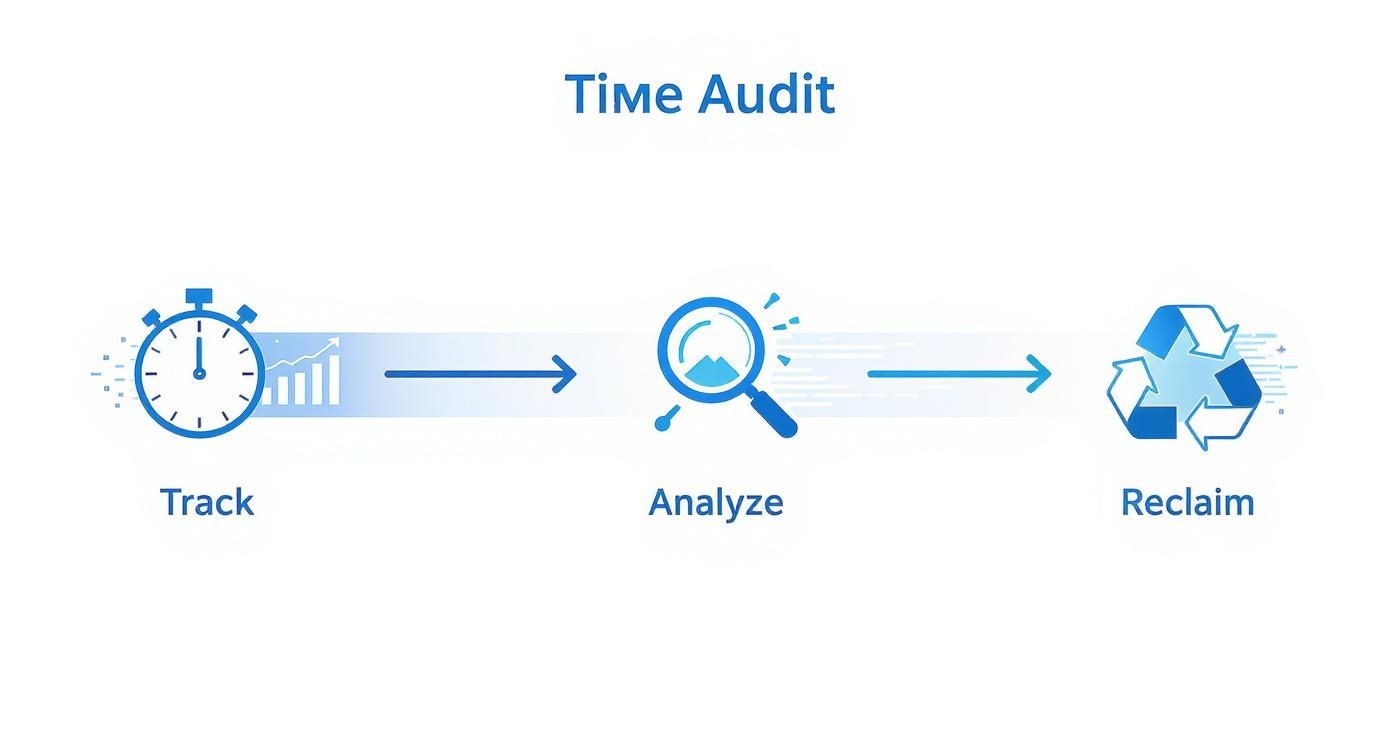
Think of the hours you reclaim as the raw materials for building a better week.
From Categories to Calendar Blocks
First things first, let’s place the big rocks. Your highest-priority activities get recurring blocks on the calendar before anything else. Treat these as appointments with yourself that are just as immovable as a meeting with your most important client.
For example, maybe your time audit showed you’re sharpest in the mornings. Great. Carve out a daily two-hour "Focus Block" from 9 AM to 11 AM. This time is sacred. No email, no notifications, no distractions. Just you and your most important task.
Time blocking flips your calendar from being a passive record of what's happening to you into a strategic plan for what you will make happen. It’s the single best offensive move you can make to take back control of your week.
Another great technique is using "theme days". This is where you assign a specific focus to each day, which drastically cuts down on the mental fatigue of switching between different types of tasks.
A simple setup might look like this:
- Mondays: Planning, strategy, and admin. Get the week set up for success.
- Tuesdays & Wednesdays: Client meetings and collaborative work. Batch them together.
- Thursdays: Deep work and project development. No interruptions allowed.
- Fridays: Creative tasks, professional development, and the all-important weekly review.
This approach creates a predictable rhythm, making it easier to get into a state of flow.
The Critical Role of Buffers and Flexibility
Here’s a rookie mistake I see all the time: scheduling every minute back-to-back. A schedule with zero breathing room looks perfect on paper but shatters the moment reality hits.
The solution is simple: build in buffer time.
Just add a 15-minute gap between your major blocks. This small pocket of time is your secret weapon. It’s enough time to grab a coffee, stretch your legs, or deal with that "quick question" from a colleague without derailing your entire day.
Buffers are the flexible joints that allow your structured schedule to bend without breaking. For a closer look at managing all this on your computer, our guide on the best Google Calendar app for desktop has some great tips. Ultimately, this creates a resilient roadmap for your week, giving you both structure and the agility to adapt when life happens.
Bringing Your Plan to Life with Digital Tools
A brilliant plan is just a document until you put it into action. This is where your digital calendar becomes your command centre, turning your blueprint from a list of ideas into a living, breathing schedule that actually guides your week. The right tool makes work-life planning feel less like a chore and more like a natural part of your day.
Your first move? Get those core routines into the calendar as recurring events. That daily 30-minute walk, the weekly family dinner, your non-negotiable morning focus block—set them all to repeat automatically. This simple step removes the daily friction of deciding when to fit them in. They become the fixed pillars you build your week around.
Next, give your life some visual clarity with colour-coding. Assign a specific colour to each of your main life domains: blue for deep work, green for health, yellow for family, whatever makes sense to you. This turns your calendar into an instant visual dashboard. With a single glance, you can see if one colour is taking over your week, helping you make quick adjustments to stay on track.
Automating Your Schedule with Smart Tools
Let’s be honest, nobody enjoys playing calendar Tetris. Modern tools like Calendar0 are built to do that heavy lifting for you. Instead of manually hunting for open slots, you can use simple, natural language commands to organise your time. It’s a small shift that saves a surprising amount of mental energy.
Think about all the time you spend just coordinating things. Now, you can just type what you want:
- "Find a 2-hour slot for deep work next week"
- "Schedule a 30-minute call with the design team tomorrow afternoon"
- "Book a recurring gym session every Monday, Wednesday, and Friday at 7 AM"
The AI handles the rest, finding the open time and creating the event without you having to click around. This is especially helpful in cultures where personal time is highly valued. In Germany, for example, many companies have embraced flexible, hybrid models precisely to help workers better integrate their professional and personal lives. You can find more details on these evolving work patterns in Europe over at amatum.com.
The goal is to spend less time managing your calendar and more time living your plan. The right digital tools make this possible by automating the administrative tasks that used to drain your time and focus.
Creating a Unified Command Centre
To really take control, your calendar needs to be more than just a list of appointments. Integrating your task list directly into your schedule is an absolute game-changer. When your to-dos live right alongside your time blocks, you get a much more realistic picture of what you can actually accomplish in a day. Many of the best planning apps now offer features that make this integration seamless.
A couple of my favourite keyboard shortcuts in Calendar0 are Cmd+K to bring up the command bar from anywhere on my desktop and Cmd+Shift+A to instantly see my availability. These little efficiencies add up, making it faster to schedule, reschedule, and protect the time blocks that really matter.
When you combine recurring events, smart colour-coding, AI commands, and task integration, your calendar becomes a truly powerful tool. It’s no longer just a passive record of meetings but an active partner in helping you execute your ideal week.
Answering Your Work-Life Planning Questions
Look, it's one thing to sketch out the perfect week on paper. It's a completely different ball game to make it stick when a last-minute client request lands in your inbox.
Transitioning to a more structured plan is a process, and it always brings up a few questions. Let's tackle the most common hurdles people hit when they start putting their new schedule into action.
"What If My Schedule Is Too Unpredictable?"
I hear this a lot, especially from people in client-facing roles or fast-moving industries. If your work life feels like a constant firefight, trying to control every single minute is a recipe for burnout.
So don't. Instead, focus on what you can control.
The most effective strategy I've found is to bookend your day with solid morning and evening routines. These become your non-negotiables. From there, block out your most important personal time first—things like your daily workout or dinner with the family—and let the more flexible work tasks flow into the gaps.
The goal isn't perfect rigidity; it’s about creating a reliable structure amidst the chaos. Your plan provides the foundational pillars, even if the walls need to be flexible.
This approach ensures your personal priorities are always ring-fenced, giving you a stable base no matter how messy the workday gets.
"How Do I Handle Urgent, Unplanned Tasks?"
They’re going to happen. The secret isn't to avoid them but to anticipate them. A robust work-life plan has room for the unexpected.
The key is building buffer time directly into your schedule. I recommend adding about 15-20 minutes of empty space between your major time blocks. Think of it as a shock absorber for your day.
This intentional gap gives you the breathing room to handle a quick colleague request or an unexpected call without completely derailing your plan.
And if a truly massive issue pops up that's going to eat hours of your time? Your plan gives you the clarity to make a conscious trade-off. Instead of reacting emotionally, you can look at your calendar and deliberately decide which lower-priority block gets pushed to tomorrow. You stay in control.
"How Often Should I Tweak My Plan?"
Your work-life plan should be a living, breathing document, not something you carve into stone and never touch again. Your priorities will shift, projects will evolve, and life will definitely happen.
To keep your plan useful, you need to check in with it regularly. Here’s a simple rhythm that works for me and many others:
- A Quick Weekly Review (15 mins): At the end of each week, just take a few minutes to glance back. What worked? What felt off? Make small adjustments for the week ahead—maybe a focus block needs to be longer, or a recurring task needs to shift.
- A Deeper Monthly Check-in (30 mins): Once a month, schedule a bit more time to zoom out. Are your big-picture goals still the same? Does your weekly schedule still reflect what’s most important to you across all areas of your life? This is your chance to make more significant changes.
This rhythm of regular reviews keeps your plan from getting stale and ensures it’s always working for you, not against you.
Ready to stop reacting and start designing your ideal week? Calendar0 is the AI menubar calendar that eliminates the admin and helps you schedule at the speed of thought. Get started for free and reclaim your time.

