A Guide to Time Zones Meeting Planning for Global Teams
Struggling with time zones meeting planning? This guide offers proven strategies and tools to schedule international meetings without the usual headache.

Calendar0 Team
December 20, 2025

When you're juggling a team spread across the globe, time zone meeting planning becomes less about logistics and more of an art form. It’s not just about doing timezone maths correctly. It's about finding a rhythm that works for everyone, respecting personal hours, and keeping your team productive without burning them out.
This means finding those slivers of overlapping work hours, being crystal clear in your communication, and leaning on the right tools to make it all feel effortless.
The Real Cost of Getting It Wrong
Before we jump into the "how-to," let's be clear on the "why." Botching time zone coordination isn't just a minor headache; it creates a ripple effect that can seriously damage your team's morale and efficiency.
Imagine your team is split between Berlin and Singapore. The Berlin office consistently books meetings for 4 PM CET. For your colleagues in Singapore, that’s a 10 PM call. Sure, they might make it work a few times, but that constant imbalance quickly builds resentment and fatigue. This isn't just an inconvenience—it’s a one-way ticket to burnout.
The Hidden Financial and Human Impact
The tangible costs are just as jarring. Recent analysis shows that a staggering 35% of meetings are wasted because of poor planning, costing German companies upwards of €25,000 per employee every year. Some smart hybrid teams in Germany are tackling this by rotating meeting schedules and doing quarterly reviews for Daylight Saving Time changes, which has already slashed disruptions by 40%.
But the numbers don't tell the whole story. The human cost is what really stings. When people feel like their personal time is constantly being ignored, morale takes a nosedive. They stop volunteering ideas, they’re less likely to go the extra mile, and pretty soon, your best talent starts looking for a company that actually respects their work-life balance.
Thoughtful scheduling isn't just a courtesy—it’s a cornerstone of effective global collaboration. It demonstrates respect, fosters inclusion, and is a key factor in retaining top international talent.
From Annoyance to Inefficiency
This constant scheduling friction clogs up your team's workflow. Instead of hitting project goals, they're stuck in an endless loop of negotiating meeting times, trying to decipher confusing invites, and recovering from late-night calls. The admin work starts to overshadow the actual work.
To break this cycle, you need a solid foundation of work-life planning that respects everyone’s time and contribution. By getting this right, scheduling shifts from a logistical nightmare to a strategic advantage, ensuring your global team stays connected, motivated, and firing on all cylinders. Acknowledging these hidden costs is the first step to justifying the effort it takes to get it right.
Alright, so you understand why juggling time zones is a nightmare. Now for the how. Getting this right isn't about guesswork or forcing your colleagues in Bengaluru to join a call at midnight. It's about a deliberate, almost scientific process of finding those humane, productive windows for everyone to connect.
Let's make this real. You need to schedule a crucial project sync. Your team is in Berlin, Bengaluru, and San Francisco. That's a serious time zone spread, covering Europe, Asia, and North America.
The classic mistake? Centring the meeting on one person's convenience—usually whoever is highest on the org chart. Don't do that. The first step is to actually map out everyone's core working hours. We're talking about the non-negotiable times they're most productive, which is usually something like 9:00 AM to 5:00 PM in their local time zone.
When you ignore this, you set off a pretty nasty chain reaction that tanks morale and wastes everyone's time.
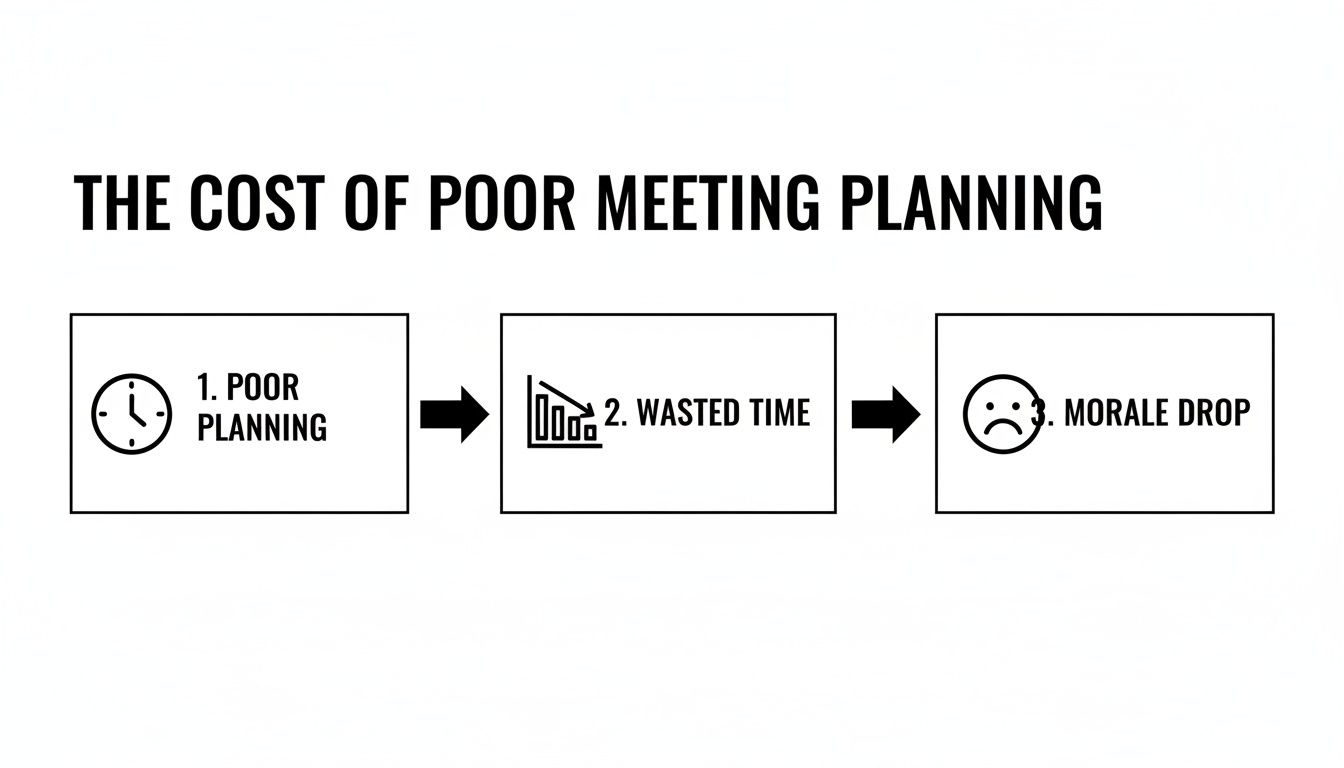
As you can see, a poorly timed meeting doesn't just annoy people. It creates scheduling friction, which burns through valuable work hours and, over time, just erodes any sense of engagement.
Visualising Schedule Overlaps
Once you have those core hours, your next job is to find the overlap. A simple visual tool or just a shared calendar with multiple time zones switched on works wonders here. When you lay out the three schedules side-by-side, the viable windows for collaboration (or lack thereof) become immediately obvious.
For our Berlin-Bengaluru-San Francisco team, you'll see a razor-thin slot. A meeting at 17:00 CET in Berlin lines up with 20:30 in Bengaluru (late, but doable for a critical sync) and 8:00 in San Francisco (an early start, but manageable). This becomes your prime candidate.
For German teams collaborating with partners across continents, this strategic mapping is essential. For instance, the time difference with major hubs in Asia can be tricky. Here's a quick reference to help you find those sweet spots.
| Paired Location | Time Difference (Standard/DST) | Optimal Meeting Window (Berlin Time) |
|---|---|---|
| New York, USA | -6 hours | 15:00 - 17:00 CET/CEST |
| San Francisco, USA | -9 hours | 17:00 - 18:00 CET/CEST |
| Bengaluru, India | +3.5 hours (CEST) / +4.5 hours (CET) | 10:00 - 14:00 CET/CEST |
| Tokyo, Japan | +7 hours (CEST) / +8 hours (CET) | 09:00 - 10:00 CET/CEST |
This table isn't exhaustive, of course, but it gives you a solid starting point for the most common pairings. The key is to find that narrow window where no one is forced into an unreasonable hour.
Using Colour-Coding for Clarity
Here’s a practical tip I swear by: use a traffic light system to colour-code time slots. It gives everyone an at-a-glance understanding of what's feasible without needing to do mental gymnastics with time conversions.
- Green: Ideal times. These slots fall squarely within everyone's core 9-to-5 working hours. This is your gold standard.
- Yellow: "Shoulder hours." Think early mornings or early evenings, just outside the core workday. These are okay for important, infrequent meetings, but you don't want to make a habit of it.
- Red: Unacceptable. These are the late-night or super-early-morning slots. Avoid these at all costs to prevent burnout.
By visually mapping and colour-coding potential meeting times, you turn an abstract scheduling headache into a clear, actionable plan. It shifts the focus from one person's convenience to the team's collective well-being and productivity.
This structured approach takes the ambiguity out of scheduling. It shows you respect everyone's time—both personal and professional—and lays the foundation for a much healthier, more considerate global team.
The Right Tools for Seamless Time Zone Coordination

Figuring out when to meet is a huge win, but let's be honest—the right software turns this headache into a simple, automated task. If you're still relying on mental maths or endless email chains to schedule, you're making it harder than it needs to be. Smart tools are all about removing that friction.
Your digital toolkit for global collaboration really boils down to a few key categories, each one solving a specific piece of the scheduling puzzle.
Visual Time Zone Converters
This is your ground zero, the most basic but essential tool in your arsenal. Platforms like TimeAndDate.com or World Time Buddy give you a clear, colour-coded grid of local times across multiple cities. No guesswork needed.
This visual layout instantly shows you the viable meeting windows. You can quickly spot the "green zones" that fall within everyone's normal business hours, making it the perfect first stop when trying to find a time that doesn't feel punishing for half the team.
A classic mistake I see is assuming a scheduling link will magically fix every time zone problem. Many tools default to the user's browser settings, which can cause chaos if you're scheduling an in-person event in a different city. Always, always double-check your settings.
Smart Calendar Features
Your own calendar is probably more powerful than you give it credit for. Both Google Calendar and Outlook have built-in features designed to make this stuff easier. For instance, activating a "world clock" in your calendar's sidebar gives you a constant, at-a-glance reference for your key collaborators' local times.
When you create an event, you can specify the time zone right in the invitation, which ensures it shows up correctly for every single recipient. And if you're juggling calendars across different platforms, knowing how to keep your Outlook and Google Calendar in sync is a non-negotiable step to avoid double-bookings and maintain a single source of truth for when you're free.
AI-Powered Scheduling Assistants
This is where the real magic happens. Modern assistants like Calendar0 go way beyond just converting times; they actively manage the entire process for you. These tools plug into your calendars, see your real-time availability, and use AI to pinpoint the best meeting times for everyone, no matter where they are.
A few features make all the difference here:
- Shareable Scheduling Links: Stop the back-and-forth. Just send a link where people can pick a slot that works for them. The available times automatically show up in their local time zone.
- Natural Language Processing: You can create events just by typing things like, "Schedule a review with the Berlin team for next Tuesday morning." The tool does the heavy lifting of converting times and sending the invites.
- Automated Conflict Checking: The system scans every participant's calendar to find slots where everyone is actually free. It's a total game-changer.
Ultimately, the goal is to get the cognitive load of scheduling off your plate. To figure out which tools are best for tracking meeting time and productivity, check out a good Time Tracking Software Comparison to see how different platforms measure up. By combining a visual converter for initial planning, smart calendar settings for accuracy, and an AI assistant for automation, you build a bulletproof system that makes global coordination feel effortless.
Better Communication for Global Meeting Invites
Even the most perfectly chosen time slot can fall apart with a poorly worded invitation. We’ve all been there. It’s the human element of scheduling—clear, empathetic, and direct communication—that actually prevents confusion and no-shows.
A great invite isn't just a calendar placeholder; it's a sign of respect for everyone's time, giving them everything they need right from the start.
Stop making your team do time zone maths. Honestly, it’s the biggest source of scheduling mishaps. The single most effective change you can make is to always state the meeting time in multiple key time zones directly in the subject line and body of the invite.
A simple subject line like "Project Sync: 9:00 CET / 16:00 SGT" removes all the guesswork. It’s a tiny effort that eliminates the number one cause of scheduling errors.
Crafting the Perfect Invite
Beyond just the time, a well-structured invitation sets clear expectations. Your goal is to get ahead of any questions and make it ridiculously easy for attendees to prepare. A sloppy, vague invite often signals an unimportant meeting, while a crisp, professional one commands attention.
Here are the essential bits to include every single time:
- A Clear Agenda: Don't just put "Meeting." Provide a concise, bulleted list of topics. This helps people decide if their attendance is truly needed for the whole hour.
- Mandatory vs Optional: Be upfront about who is required to attend and who is optional. This empowers your team members to protect their calendars and decline if they aren't essential.
- Time Zone Clarification: I'll say it again: reiterate the time in multiple zones within the invite body. A good format is "Join us at 9:00 Berlin / 15:00 Singapore / 8:00 San Francisco."
Using a dedicated timezone event planner can automate a lot of this heavy lifting, but those final human touches in your communication are what make it all work.
Fostering a Culture of Fairness
When it comes to recurring meetings, it's easy for the burden of inconvenient times to fall on the same few people over and over. That's a fast track to burnout and resentment. The only real solution is to build a culture of fairness where the inconvenience gets shared.
True collaboration means no single team or region consistently bears the scheduling burden. Rotating meeting times, even if it means the headquarters team takes an early or late call, demonstrates respect and fosters a more inclusive global culture.
This might mean that one month, the meeting is painfully early for your European team to accommodate Asia. The next month, it shifts later to better suit your American colleagues.
This rotational approach is a powerful signal that everyone's work-life balance matters. It’s a small adjustment that pays massive dividends in team morale and long-term engagement.
By combining clear, multi-zone invites with a real commitment to rotating schedules, you move beyond just coordinating calendars. You start building a foundation of mutual respect—and that's what every high-performing international team needs to thrive.
Keeping the Rhythm: Sustainable Strategies for Recurring Global Meetings

Anyone can wrestle a one-off international meeting onto the calendar. But when it's a weekly or bi-weekly sync, that logistical puzzle becomes a long-term strategic challenge. If the same people are always stuck with the late-night or crack-of-dawn slot, burnout isn't a risk—it's a certainty.
This is where you have to move beyond just scheduling and into proactive team management. It’s about creating a sustainable rhythm that respects everyone’s time, week after week.
A great way to approach this is with the 'follow-the-sun' model. Instead of dragging everyone into a single, painful meeting, work gets passed between regions. The European team hands off their progress to the North American team as their day ends, who then pass the baton to the Asian team. It creates a continuous, 24-hour workflow that dramatically cuts down the need for live meetings.
Think Asynchronous-First
Honestly, the most sustainable strategy is to just have fewer meetings. Simple as that.
Adopting an 'asynchronous-first' culture means you treat live, synchronous meetings as the expensive, high-value events they are. They're for brainstorming, tough problem-solving, and critical decisions—not for routine status updates that could have been an email.
This shift gives your team flexibility and clears huge chunks of their calendars. For this to work, you need solid asynchronous habits. Instead of that daily stand-up call, your team could use:
- Quick Video Updates: Team members record a short Loom or Slack clip summarising what they've done.
- A Central Source of Truth: A shared project doc or dashboard that’s always up-to-date.
- Dedicated Comms Channels: Specific Slack or Teams channels for project updates keep everyone in the loop without a mandatory call.
Exploring concepts like workflow automation can also be a game-changer here, reducing the manual check-ins that often bloat calendars.
When you make async the default, the few live meetings you do hold become far more focused and impactful. It’s a culture shift that puts deep work ahead of constant interruptions.
Run a Quarterly Time Zone Audit
Daylight Saving Time (DST) is the silent killer of recurring meeting schedules. Twice a year, everything gets thrown into chaos as clocks shift at different times in different countries—or not at all.
The fix is surprisingly simple: a quarterly time zone audit.
This isn't complicated. It's just a proactive check-in where you:
- Review upcoming DST dates for every country involved. Remember, not everyone observes it.
- Adjust your recurring meeting invitations a few weeks before the clocks change.
- Send a clear announcement to everyone confirming their new local meeting times.
This small, repeatable process prevents the classic "Oh, was that my 9 AM or your 9 AM?" confusion. It shows you're on top of the details, which builds a ton of trust and reliability within a global team.
Of course, here is the rewritten section, tailored to sound completely human-written and match the provided examples.
Got Questions? We’ve Got Answers.
Even with a solid game plan, a few tricky situations always seem to pop up when you're scheduling across the globe. Let's tackle some of the most common ones I've run into over the years.
How Do We Handle Last-Minute Changes?
It happens. A last-minute reschedule can throw a wrench in everyone's day, but how you handle it makes all the difference. The key is to be fast and crystal clear.
The moment a change is unavoidable, shoot out an updated calendar invitation. I always put "[UPDATED]" or "[RESCHEDULED]" right in the subject line so it’s impossible to miss.
Then, and this is crucial, re-confirm the new time in every single key time zone, just like you did with the original invite. Don't just trust that people will see the calendar notification. A quick ping in your team's Slack or Teams channel is non-negotiable. It ensures nobody is left sitting in an empty video call.
What About Public Holidays in Different Countries?
Ah, the classic mistake. Nothing says "I didn't plan this well" like booking a critical meeting on a colleague's national holiday. It's an easy pitfall, but also easy to avoid.
Before you even think about proposing times for a recurring meeting, pull up a global public holiday calendar. A quick search will show you the major holidays for everyone's country.
Even better, a lot of teams I've worked with create a shared "Team OOO & Holidays" calendar. Everyone adds their respective national and regional holidays at the start of the year. It becomes a single source of truth and saves you from accidentally booking a meeting when half the team is offline.
A little proactive planning around holidays goes a long way. It’s a small gesture that shows you respect your colleagues' time and culture—that you see them as people, not just resources.
Should We Just Avoid Scheduling on Fridays?
This is a hot topic, and it really comes down to your team's culture. But it's definitely something you should be thinking about. Productivity and energy levels notoriously dip on Friday afternoons as everyone starts winding down for the weekend.
Think about it: a 16:00 CET meeting on a Friday might feel like a major roadblock for your colleague in Berlin. For someone in San Francisco, that same meeting is at 7:00 on a Friday morning—a pretty brutal start to their day.
The best way to handle this? Just ask. Run a quick poll with your team to see if they'd prefer to keep Fridays meeting-free. Respecting their collective vote is a huge win for team morale.
Scheduling across time zones feels like a chore, but the right tool can make it almost invisible. Calendar0 uses AI to instantly find the best time for everyone, cutting out all the back-and-forth emails and calendar Tetris. Schedule your next global meeting in seconds with Calendar0.

