threema vs signal: Which secure messenger wins?
threema vs signal: compare privacy, security, and features to choose the right encrypted messenger for you.

Calendar0 Team
November 17, 2025

When it comes to picking a secure messenger, the Threema vs Signal debate really boils down to a single question: what’s your primary goal?
If you need absolute anonymity and watertight GDPR compliance, especially for business, Threema is the clear winner. But for most people just wanting a free, widely-used, and incredibly secure app, Signal is tough to beat.
Choosing Your Secure Messenger: Threema vs Signal
Deciding between these two privacy champions means understanding their core trade-offs. The fundamental difference lies in how they handle your identity and their business models. Threema is a paid app that asks for zero personal information. Signal is a free, donation-funded service that links your account to your phone number.
This simple infographic gets right to the heart of the decision.
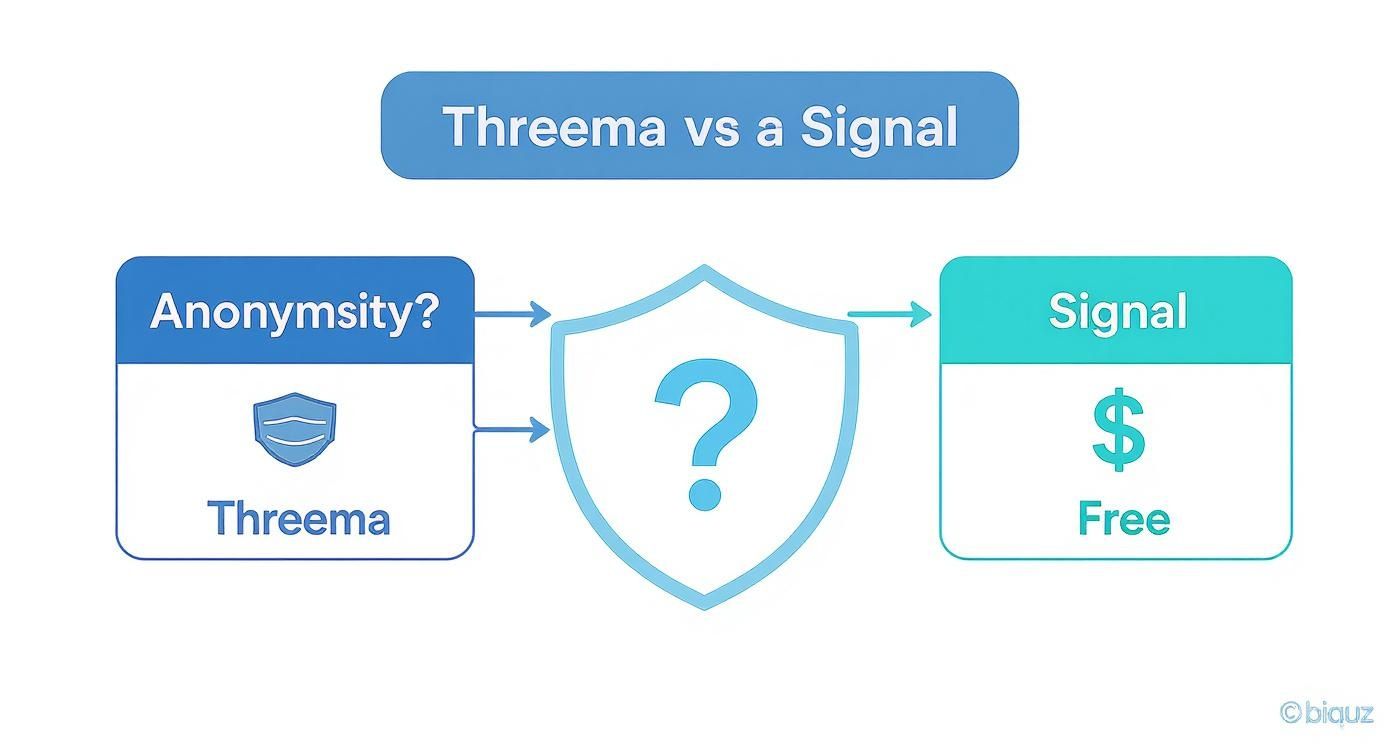
As you can see, it’s a straightforward choice. If your main concern is staying anonymous by not using a phone number, Threema is the way to go. If cost is the dealbreaker, then Signal is your answer.
Threema vs Signal At a Glance
To give you a clearer picture, I've put together a quick comparison table highlighting the most critical differences. This should help you make an informed decision without getting lost in the technical weeds.
| Feature | Threema | Signal |
|---|---|---|
| Registration | Anonymous (No phone number or email required) | Requires a phone number |
| Pricing Model | One-time purchase | Completely free (Donation-based) |
| Server Location | Switzerland (Strong privacy laws) | United States (Subject to US laws like the CLOUD Act) |
| Anonymity | High. Can be used without any personal identifiers. | Medium. Your phone number links the account to you. |
| Primary Audience | Businesses, journalists, activists, privacy purists. | General public, privacy-conscious individuals. |
This table cuts through the noise. It's not about which one is "better" overall, but which one better fits your specific needs for privacy, cost, and legal protection.
Understanding the Trade-Offs
When you choose Threema, you're paying for a service that completely decouples your real-world identity from your messaging account. This is a massive deal for journalists, lawyers, or anyone whose work involves highly sensitive information. Plus, its Swiss jurisdiction provides a legal shield that you just don't get with services based in the US.
On the other hand, Signal’s free model and its use of phone numbers for contact discovery have made it incredibly popular, giving it a huge network of users. It offers world-class encryption to everyone at no cost, which makes it a fantastic choice for everyday secure chats with friends and family.
Ultimately, your decision comes down to this: do you prioritise the huge user base and free access of Signal, or the absolute anonymity and business-ready compliance of Threema?
Comparing the Core Privacy Philosophies
To really understand the Threema vs Signal debate, you have to look past the feature lists. It’s their core philosophies that define everything, from how you sign up to how the lights are kept on. These aren’t just technical details; they represent two fundamentally different ideas of what private communication should be.
Threema is built on a foundation of absolute anonymity and financial independence. Its entire model hinges on a simple idea: true privacy is a product worth paying for. By charging a small, one-time fee, Threema guarantees its only loyalty is to you, the user—not advertisers or investors.
This paid-first approach is what enables Threema to demand zero personally identifiable information. You don’t need a phone number or an email to get started. That simple fact completely severs the link between your digital identity and your real-world self.
Threema: The Swiss Privacy Fortress
Threema's Swiss jurisdiction isn't just a marketing point; it's a core part of its privacy promise. Switzerland’s notoriously strong data protection laws create a legal shield that puts individual privacy above government data grabs. This "privacy by design" ethos has been baked into its DNA from day one.
This commitment struck a chord at key moments in the public’s privacy awakening. After Facebook bought WhatsApp in 2014, for example, Threema’s user base doubled in just 24 hours, adding 200,000 new users looking for a safe haven. You can dig into Threema’s history and its responses to major privacy events on its Wikipedia page.
Threema’s philosophy boils down to this: “If you are not paying for the product, you are the product.” By making users its customers, there’s no incentive to sell their data. Its business goals and your privacy are perfectly aligned.
Signal: Privacy as a Public Good
Signal takes a completely different tack. Its philosophy is that privacy is a fundamental right, not a premium feature. Run by the non-profit Signal Foundation, its mission is to make top-tier secure communication free for everyone, everywhere. All its costs are covered by grants and donations from users who believe in the cause.
Because it's a non-profit, Signal has zero commercial reason to compromise your privacy. The trade-off? To make the app as accessible and user-friendly as possible, it uses phone numbers for registration and finding contacts. While this makes getting started incredibly simple, it does tie your account to a major piece of personal information.
Knowing how any service handles your data is critical. It’s always smart to review a company's policies to see what they're committed to. For an example of what to look for, you can read our own detailed privacy policy.
Ultimately, choosing between Threema and Signal means choosing between two different privacy models. Threema offers unparalleled anonymity for a small price, while Signal delivers elite, accessible security for free, asking only for your phone number in return.
Under the Bonnet: A Technical Look at Security and Privacy
When you really dig into the Threema vs Signal debate, the meaningful differences show up in the technical details. Both apps offer top-tier security, but they get there using different cryptographic philosophies and approaches to data handling. Taking a closer look at how they protect your conversations reveals the critical role of encryption in information security.
Signal is rightly famous for its Signal Protocol. It’s become the gold standard for end-to-end encryption, so much so that giants like WhatsApp and Skype have adopted it. The magic is in its "double ratchet" algorithm, which provides perfect forward secrecy. In simple terms, even if someone managed to steal a key, they couldn't use it to decrypt your past messages. It’s a brilliant piece of security engineering.
Threema takes a different, but equally respected, path. It relies on the NaCl (Networking and Cryptography library). Think of NaCl as a high-level, battle-tested cryptographic toolkit that also delivers rock-solid end-to-end encryption for everything you do in the app. While it's not the Signal Protocol, NaCl is heavily audited and trusted by security experts for its raw performance and reliability.
How They Handle Your Metadata
Often, it’s not what you say, but who you say it to (and when) that matters most. This is metadata, and it’s where Threema really starts to pull away from the competition.
Threema was built from the ground up on a zero-metadata architecture. Registration is completely anonymous—no phone number needed—and messages are routed in a way that makes it nearly impossible to link a sender to a receiver. As a result, Threema's servers simply don't generate or store logs or connection data.
The core idea behind Threema is simple: if data is never collected in the first place, it can never be stolen, leaked, or handed over to authorities. This is privacy by design at its absolute best.
Signal, while still excellent, opts for a "minimal metadata" approach. It collects only what is absolutely necessary for the service to work, like the date a user last connected. Signal has famously demonstrated in court that it cannot hand over message content or contact lists, but because it’s tied to your phone number, some metadata is created by default.
The Decisive Factor: Where the Servers Live
For a growing number of users, particularly in Europe, the physical location of an app's servers isn't just a detail—it's a deal-breaker. This is arguably Threema’s strongest advantage.
- Threema: All its servers are located in Switzerland, a country with some of the most robust data privacy laws on the planet. This makes it fully compliant with GDPR right out of the box.
- Signal: Its servers are based in the United States, putting it squarely under US jurisdiction. This means it's subject to laws like the CLOUD Act, which creates serious legal headaches for businesses and individuals concerned about cross-border data transfers.
This isn't just a theoretical problem. In data protection assessments, Threema scored a perfect 300 points for privacy compliance, a feat largely attributed to its Swiss foundation. By contrast, Signal received just 50 points. That huge gap is a direct result of the 'Schrems II' ruling by the European Court of Justice, which cast major doubts on the legality of transferring EU data to the US. For anyone who values data sovereignty, this legal distinction is one of the most critical differentiators in the Threema vs Signal discussion.
A Practical Look at Features, Messaging, and Usability
Top-tier security is great, but let's be honest—if an app is a pain to use, it won't last long on anyone's phone. The day-to-day experience is what really matters. When we get down to the nitty-gritty of Threema vs Signal, both feel polished and modern, but how they get you started speaks volumes about their core philosophies.
If you’ve ever used WhatsApp, Signal’s onboarding will feel instantly familiar. It’s almost frictionless. The app scans your contacts, finds other Signal users automatically, and you can start chatting in seconds. It’s designed for mass adoption.
Threema takes a very different path, putting anonymity front and centre from the moment you open the app. There's no phone number required. Instead, you generate a unique, random Threema ID. To add someone, you either scan their QR code in person or share your ID with them. This is a deliberate, manual process, but that's the point—it adds a significant layer of privacy.
Core Messaging Features
When it comes down to the basics—one-on-one chats, group messages, sending photos—both apps nail it. They're fast, reliable, and get the job done without a fuss. But once you dig a little deeper, some key differences emerge that might sway your decision.
- Group Chats: Both handle group messaging well, but Threema has a few extra tricks up its sleeve, like built-in polls. It’s a small thing, but incredibly handy for organising team lunches or making group decisions without a dozen "I'm good with that" replies.
- File Sharing: Signal gives you a bit more breathing room here, with a 100 MB file size limit compared to Threema’s 50 MB. For most pictures and documents, it's not a big deal. But if you’re regularly sharing large videos or uncompressed audio, that extra space on Signal could be a lifesaver.
- Unique Touches: Threema has a neat little "agree/disagree" feature. Instead of typing out a response, you can just tap a thumbs-up or thumbs-down on a message. It’s surprisingly efficient for getting quick feedback.
This is the fundamental trade-off. Signal leans into convenience and the network effect, making it dead simple to connect with people you already know. Threema forces a more conscious, deliberate approach to building your contact list, prioritising verified, private connections over ease of discovery.
Detailed Feature and Usability Showdown
To make the comparison clearer, here’s a direct, side-by-side look at what each app brings to the table in terms of features and overall user experience.
| Aspect | Threema | Signal |
|---|---|---|
| Onboarding | Anonymous Threema ID creation. Requires manual contact adding via QR code or ID sharing. | Phone number-based. Automatically discovers contacts who also use Signal. |
| Group Chat Limit | 256 members | 1,000 members |
| Group Chat Features | Polls, agree/disagree function, distribution lists for one-way announcements. | Standard messaging, @mentions, disappearing messages. |
| Max File Size | 50 MB | 100 MB |
| Disappearing Messages | No | Yes, configurable timers for chats. |
| Desktop App | Threema Web (requires phone connection), dedicated desktop apps. | Standalone desktop app (links to phone but can operate independently). |
| Platform Support | iOS, Android, Web, macOS, Windows, Linux. | iOS, Android, macOS, Windows, Linux. |
This table highlights the design choices each app makes. Signal aims for a feature-rich experience that rivals mainstream messengers, while Threema focuses on a core set of secure communication tools with unique features geared toward privacy and organisation.
Voice and Video Call Quality
Let's cut to the chase: for end-to-end encrypted calls, both Threema and Signal are outstanding. Over any decent Wi-Fi or mobile connection, the call clarity is crystal clear on both platforms. You won't feel like you're sacrificing quality for privacy.
Signal has a well-deserved reputation for crisp, reliable calls, which is a testament to the years of work its non-profit team has poured into optimisation. But Threema is right there with it, delivering robust and secure calls without any noticeable lag or drop-offs.
Honestly, it's a dead heat. For the core function of making a private call, you can't go wrong with either. The real decision comes back to which app's philosophy on identity and contact management fits your needs best.
Who Actually Uses These Apps, and Why?
Forget the technical specs for a moment. The real story is in who uses these apps and why. The user bases for Threema and Signal aren't interchangeable; each app has carved out a specific niche built on trust, functionality, and a certain kind of reputation.
Signal has become the default secure messenger for a massive global audience. Think journalists, activists, and anyone even slightly aware of privacy issues. Its free-to-use model and heavyweight endorsements from people like Edward Snowden have made it a household name in security circles. If your main threat is surveillance and you need a reliable, no-cost way to talk to people across the globe, Signal is the obvious choice. The network effect here is huge—your friends are probably already on it.
Threema's European Stronghold
Threema, on the other hand, has a deep and fiercely loyal following in privacy-obsessed regions, especially the DACH countries (Germany, Austria, Switzerland). Its paid, anonymous model works perfectly in markets where data protection isn’t just a nice-to-have, but a core cultural and legal value. This is especially true in the business and public sectors.
Take Germany, a country known for its strict data protection laws. Threema holds about 3% of the messaging market share among internet users there, which is a big deal for a paid app. That figure represents a conscious decision by people and organisations to pay for privacy instead of defaulting to a free alternative. You can dig into the data on German messaging app preferences to see just how strong this trend is.
Here’s the key difference: Signal's popularity is driven by its accessibility and its reputation for protecting individuals. Threema's growth comes from its institutional-grade privacy, making it the trusted choice for organisations that can't afford any compromise on data sovereignty or user anonymity.
So, Which One Fits Your Situation?
This split creates clear use cases. An international human rights group would likely standardise on Signal so its global network can communicate freely and at no cost. But a Swiss law firm or a German engineering company would choose Threema Work to ensure GDPR compliance and protect client data without tying employee phone numbers to the service.
When you're weighing Threema vs Signal, think about which of these communities you fit into. Your answer will probably make the choice a lot clearer.
Making the Right Choice for Your Needs

The whole Threema vs Signal debate isn’t about finding one “best” app. It's about matching the right tool to your personal threat model. Your choice should come down to what you genuinely value most in a private messenger.
So, let's get straight to it. First, you have to define your main goal. Are you after absolute anonymity, no matter the cost? Or is your priority free, widely-trusted security that’s easy for anyone to use? Answering that one question will point you in the right direction.
For Businesses and Privacy Purists
If you're an EU-based business, a journalist protecting sensitive sources, or just someone who prioritises true anonymity above everything else, Threema is your definitive choice. It operates under strict Swiss jurisdiction and its zero-data policy makes it inherently GDPR-compliant. The fact that you don't need a phone number to register offers a level of privacy Signal simply can't provide.
Threema’s one-time purchase fee isn't a barrier; it's a feature. It ensures the service is accountable only to its users, not donors or external funders, aligning its business model directly with your privacy.
This focus on organisational privacy is a big deal. For instance, if you're managing professional communications, you need more than just secure messages—you also need tools like a secure task manager that operate on the same principles of data integrity.
For Activists and Everyday Users
On the other hand, if you’re an activist coordinating a global network, a privacy-conscious individual, or just need a simple, free, and incredibly secure tool, Signal is the ideal solution. Its non-profit status and reliance on the gold-standard Signal Protocol have earned it massive trust all over the world.
The real advantage here is the network effect. Since Signal uses phone numbers for contact discovery, your friends and family are probably already on it. That makes getting started completely frictionless. It puts elite-level security in the hands of the masses at no cost, and that’s a powerful mission.
Ultimately, the choice boils down to a pretty straightforward trade-off:
- Choose Threema for paid, anonymous, business-grade privacy.
- Choose Signal for free, accessible, and globally trusted security.
Once you understand these core differences, you can confidently pick the messenger that actually protects what matters most to you.
Frequently Asked Questions
Even after a deep dive, a few common questions always pop up when comparing Threema and Signal. Let's tackle them head-on to clear up any lingering confusion.
Is Threema More Private Than Signal?
Yes, in a practical sense, Threema offers a higher degree of privacy. While both apps have world-class end-to-end encryption, the key difference lies in anonymity.
Threema lets you sign up without a phone number or email, making it possible to use the app completely anonymously. Signal, on the other hand, requires your phone number, which immediately links your account to your real-world identity.
There's also the jurisdictional advantage. Threema is based in Switzerland, operating under some of the world's strongest data protection laws like GDPR. Signal is US-based, which can be a concern for users wary of government oversight.
It’s best to think of it this way: Threema is built for anonymity, while Signal is built for accessibility. Both are incredibly secure, but Threema goes the extra mile to sever the connection between your account and you.
Why Does Threema Cost Money While Signal Is Free?
The payment models get to the heart of their philosophies. Threema charges a small, one-time fee because its business model is you—the user. This direct funding means they have zero financial incentive to ever collect or sell your data. Their only job is to protect your privacy.
Signal operates as a non-profit foundation, running on grants and donations. This allows them to offer their service completely free, driven by a mission to make secure communication a universal right. Both paths lead to a sustainable, user-first approach, just funded in different ways.
If you're interested in how secure tools can fit into your productivity workflow, check out the guides on our blog.
Can Threema and Signal Users Message Each Other?
Absolutely not. The two apps are completely separate ecosystems. You can only message Threema users from Threema and Signal users from Signal.
This isn't a limitation; it's a security feature. Creating a bridge between two distinct, encrypted platforms would introduce massive security risks and potentially compromise the privacy guarantees that make them so trusted in the first place.
Ready to reclaim your time and streamline your schedule with AI? Calendar0 connects all your calendars, prevents double-bookings, and lets you schedule meetings with natural language. Stop the calendar admin and start focusing on what matters. Get started with Calendar0 for free.

