Life Work Planning: Master life work planning to align career and values
Discover life work planning to align your career goals with personal values and create a flexible, fulfilling roadmap.

Calendar0 Team
December 24, 2025

Life work planning isn’t about finding a perfect, mythical balance. It’s about designing a life where your career and your personal goals are allies, not competitors.
Think of it less like a rigid career ladder and more like a flexible, integrated strategy that weaves your work into the fabric of what actually matters to you. This way, your professional path genuinely adds to a fulfilling life, instead of taking away from it.

Why The Old Career Playbook Just Doesn't Cut It Anymore
Let's be honest: the old rulebook is officially broken. For decades, the script was simple. You picked a career track, climbed the corporate ladder, saved for retirement, and just hoped your personal life would sort itself out along the way.
That siloed thinking just doesn't fly anymore. The lines between our work and home lives have completely blurred, and we need a strategy that reflects this new reality. This isn’t just a gut feeling; it’s a direct response to massive shifts in how we work, live, and define success.
The New Realities Forcing Our Hand
A few key trends make this integrated approach a necessity, not just a nice-to-have:
- We’re Working Longer: It's a simple demographic fact. Many of us will have longer careers than our parents did. In Germany, for example, the working-age population is expected to shrink by 22% by 2060. This means we have to plan for careers that are not only financially rewarding but also sustainable and satisfying over the long haul.
- Flexibility is a Double-Edged Sword: Remote work and flexible hours offer incredible autonomy. But without intentional planning and strong boundaries, they can quickly lead to burnout. The "always on" culture is a real threat.
- The Search for Meaning: A paycheque is no longer enough. People want purpose. A career that clashes with your core values is a recipe for long-term dissatisfaction, no matter how good it looks on paper.
Moving past these outdated models means getting intentional. Using a flexible career goals template can be a great starting point to map out a path that feels authentic to you.
And when it comes to managing the day-to-day chaos of an integrated schedule, new tools can make all the difference. Our guide on planning with artificial intelligence dives into practical ways you can get technology to do the heavy lifting for you.
Defining What Truly Matters to You

Before you can build any kind of meaningful plan, you need a solid foundation. And in life-work planning, that foundation is a gut-level, crystal-clear understanding of what you truly value.
This goes way beyond generic goals like “be successful” or “spend more time with family.” We’re talking about digging deeper to uncover the non-negotiables that will act as your compass, especially when the path gets foggy.
Without this clarity, it’s all too easy to chase career milestones that feel hollow or make financial decisions that don't actually support the life you want to live. The real goal is to connect your daily actions to your deepest personal principles, making sure every step you take is a step in the right direction.
Moving from Vague Ideas to Core Principles
First things first: a bit of honest self-assessment. Forget what you think you should value and focus on what genuinely drives you.
Think about moments when you felt most fulfilled. Or, just as telling, when you felt most frustrated. What was really at the core of those feelings? More often than not, those emotions point directly to your values.
To turn those feelings into something you can actually work with, start thinking about these key areas of your life:
- Career & Growth: What does professional fulfilment look like for you, beyond a title or a paycheque? Is it autonomy? Creative expression? Mentoring others? Or maybe it’s just good old-fashioned stability?
- Health & Wellbeing: What are your non-negotiables for your physical and mental health? This could be something as simple as a daily walk, protected downtime with no screens, or sticking to healthy eating habits.
- Finances & Security: What role does money really play in your life? Is it a tool for freedom and experiences? A measure of security? Or a way to provide for the people you love?
- Relationships & Community: Who are the essential people in your life, and what kind of presence do you want to have for them? Are you the reliable friend, the present parent, the supportive partner?
To help organise these thoughts, a simple framework like a priority matrix can be incredibly useful. It forces you to connect your abstract values to concrete goals.
Your Personal Priority Matrix
This table is a practical framework for ranking and aligning your priorities across key life domains to create a balanced plan.
| Life Domain (e.g., Career, Finance, Health, Family) | Core Value Driving This Domain | Short-Term Goal (1-2 Years) | Long-Term Aspiration (5-10 Years) |
|---|---|---|---|
| Career | Creativity & Autonomy | Launch a side project | Transition to full-time self-employment |
| Finance | Security & Freedom | Build a 6-month emergency fund | Become debt-free, including the mortgage |
| Health | Energy & Longevity | Run a 10k race | Establish a lifelong fitness routine |
| Family | Presence & Connection | Plan a screen-free family holiday | Be actively involved in children's education |
Filling this out gives you a one-page snapshot of what matters, making it much easier to see where your daily efforts should be focused.
Once you’ve reflected on these areas, try to pull it all together into a personal mission statement. For example: "My mission is to build a life of financial independence that allows me to be fully present for my family's milestones, pursue creative projects, and protect my mental health."
This isn't just a nice-sounding phrase to stick on a Post-it note. It’s your decision-making filter. When a new career opportunity comes along, you can ask, "Does this actually align with my mission?" This is especially powerful when navigating big life events like planning for Elternzeit (parental leave) or a sabbatical, ensuring these periods enrich your life instead of derailing your long-term vision.
Acknowledging Real-World Factors
Of course, great planning also has to account for reality. In Germany, for instance, things like the gender pay gap and career interruptions for caregiving aren't just abstract concepts; they have a massive financial impact over a lifetime. Planning for these possibilities isn't pessimistic—it's just smart.
This is where a more proactive mindset comes in. I love the idea of being the virtual assistant of your own life. It shifts you from just reacting to whatever comes your way to proactively designing a life where your work and personal goals actually support each other.
Creating Your Flexible Five-Year Roadmap
Now that you’ve defined your core values, it's time to draw the map. Think of a five-year roadmap not as a rigid, unchangeable script for your life, but as a flexible guide. It’s the bridge connecting your long-term ambitions to the practical, everyday steps you need to take.
The real magic of this kind of life work planning is setting interdependent milestones. Your personal and professional goals don't live in separate universes—they constantly influence each other. A decision in one area sends ripples across all the others.
For example, deciding you want to buy a home in three years isn't just a financial goal. It has a direct knock-on effect on your career. You might need to chase that promotion, look for a higher-paying job, or start freelancing on the side. That, in turn, eats into the time you have for hobbies or family, forcing you to make conscious trade-offs that align with your bigger mission.
Mapping Your Ambitions Year by Year
To start building your roadmap, think in broad themes for each year. This keeps you from getting bogged down in the tiny details and maintains focus on the bigger picture. Remember, the goal here is progress, not perfection.
A simple structure can help you organise your thoughts. Think of it as a rough sketch for your ambitions:
- Year 1 Focus: Foundation & Upskilling. This year is all about setting the stage. You might prioritise clearing high-interest debt, finishing a certification (Weiterbildung), or finally locking in a consistent health routine. The aim is to build momentum.
- Year 2 Focus: Growth & Exploration. With a solid base, you can start pushing your boundaries. This could be the year you apply for a promotion, launch that side project you can't stop thinking about, or take that big family trip.
- Year 3 Focus: Major Milestone Execution. This is often the year for a big move you've been working towards—like buying that house, making a significant career change, or hitting a major savings target.
- Year 4 Focus: Optimisation & Refinement. After a major push, this year is about fine-tuning your systems. You might refine your budget, delegate more at work, or focus on improving your work-life balance based on what you’ve learned.
- Year 5 Focus: Re-evaluation & Future Planning. In the final year, you’ll take stock of your progress, celebrate the wins, and start sketching out your next five-year roadmap. It's a continuous cycle of growth.
A plan is a living document, not a stone tablet. Research shows that people who regularly review their goals are significantly more likely to achieve them. The most successful plans are those built to bend without breaking.
Building in Flexibility and Course Correction
Let's be honest: life is unpredictable. A career shift, a family illness, or a wild opportunity can appear out of nowhere. A truly effective plan anticipates this by having flexibility baked in from the very start.
This is where regular check-ins become absolutely critical. Schedule a quarterly review with yourself—put it right in your calendar—and ask a few simple questions:
- Am I still moving in the right direction?
- Do these goals still feel right and align with my core values?
- What's new? What information or circumstances do I need to factor in?
These reviews aren't about judging your progress harshly. They're about making intelligent adjustments to stay on course. Maybe a career goal gets pushed back a year to accommodate a family need, or a financial target has to be adjusted. This adaptability is precisely what makes the plan resilient and, most importantly, realistic.
Trying to manage all these moving parts in your head is a recipe for disaster. Using one of the best planning apps can be a game-changer. These tools help you visualise your timeline, set reminders for your check-ins, and keep your personal and professional milestones all in one organised place. By embracing this kind of flexible approach, you empower yourself to navigate life’s inevitable curveballs with confidence instead of feeling derailed.
Turning Your Plan into Daily Action
A grand roadmap is a beautiful thing, but it's only as good as its execution. This is where the rubber meets the road—where your high-level planning connects with the reality of your daily schedule. The trick is to translate that five-year vision into tangible, weekly actions without getting overwhelmed.
The goal isn't to cram more into your day. It’s about making sure the time you do spend is on what you've already decided truly matters. When you design your week with intention, you carve out protected space for deep work, family time, your health, and learning new skills—the very pillars of the life you’re building.
It's a simple, three-step flow: define what matters, plan your moves, and then act on them consistently.
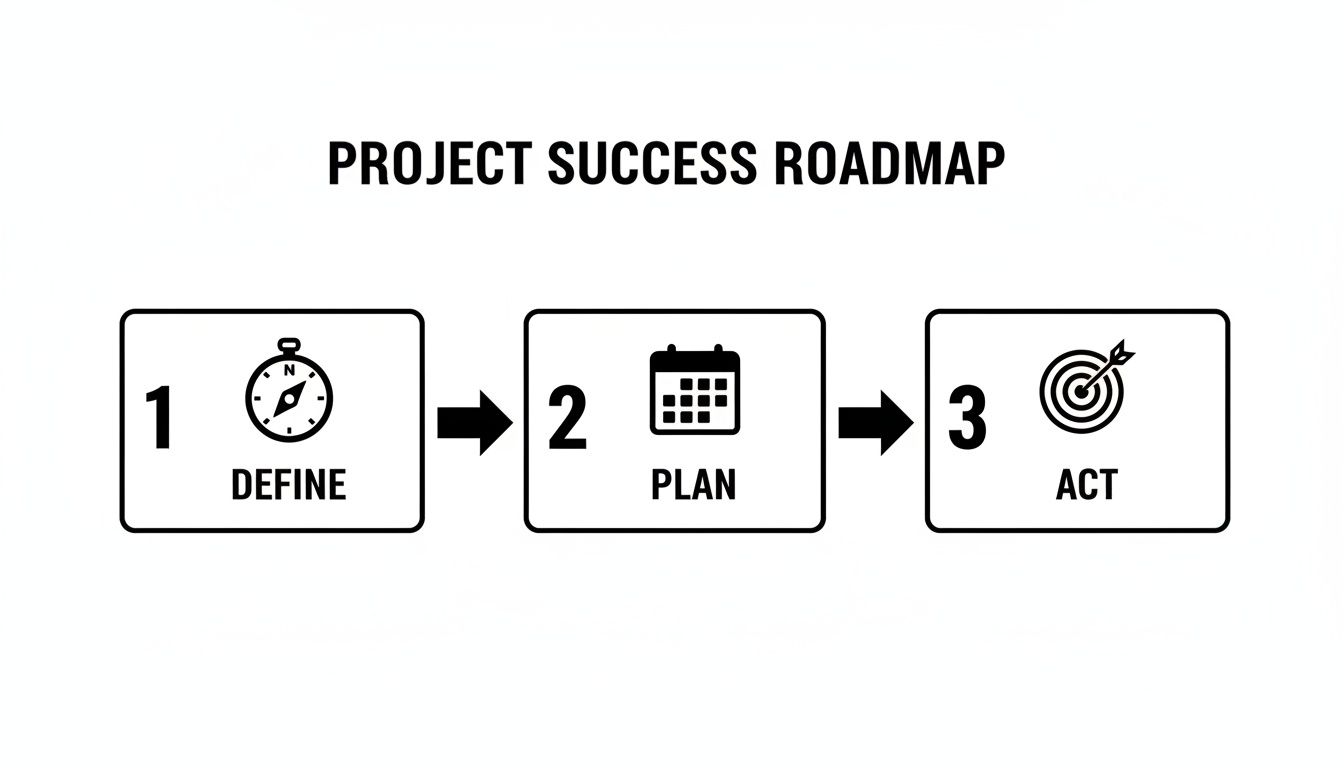
As you can see, that final step—consistent action—is what breathes life into all the initial planning and defining.
Master Your Week with Time Blocking
One of the most powerful ways to make this happen is time blocking. Forget working from a never-ending to-do list that just leaves you feeling reactive. Instead, you proactively assign a specific job to every block of time in your calendar. This simple shift is a game-changer for reducing decision fatigue and protecting your focus.
Think of it as making appointments with your priorities. You wouldn't just blow off a client meeting, so why treat your personal goals with any less respect?
This technique is a particularly great fit for the German work culture. With relatively short annual work hours (around 1,335) and a generous 30 days of leave, the structure itself encourages deliberate planning. People are already used to scheduling their lives around non-work commitments, making time blocking a natural extension of that mindset.
By assigning every minute a mission, you reclaim control over your day. You stop reacting to what’s urgent and start focusing on what’s important.
Unify Your Calendars for Total Clarity
One of the biggest hurdles I see people face is juggling multiple calendars. They have one for work, one for their personal life, and maybe another for family stuff. This fragmented system makes it impossible to get a real, honest picture of your time, leading to double-bookings and that constant, draining feeling of context switching.
The solution is to get everything into a single, unified view. Modern tools like Calendar0 were built for exactly this, pulling all your calendars into one clean interface without compromising your privacy.
Here’s a simple way to set it up for effective planning:
- Colour-code everything. This is non-negotiable. Assign a unique colour to each area of your life—maybe blue for work, green for health, and orange for family. It gives you an instant visual read on your life-work balance for the week.
- Set recurring blocks. For your non-negotiables, like hitting the gym or having a dedicated block for deep work, create recurring events. This automates your discipline so you don't have to think about it.
- Schedule buffer time. Don't book your day back-to-back. It's a recipe for burnout. Add 15-minute buffers between meetings to grab a coffee, decompress, and get ready for what’s next.
When you integrate your roadmap directly into your daily schedule, the plan stops being a static document and becomes a dynamic guide for your life. To dig deeper, you can explore more tips for optimising your schedule in our detailed guide to using a daily planner app. This approach ensures your daily actions are always compounding towards the fulfilling life you’ve designed for yourself.
How to Review and Adapt Your Life-Work Plan
Your life doesn’t stand still, and neither should your plan. A life-work plan isn't something you create once and then file away. Think of it as a living guide that needs to evolve right alongside you. The real magic happens when you build a sustainable rhythm for checking in and adjusting your path.
This isn’t about obsessively micromanaging your every move. It's about creating intentional checkpoints to make sure your daily actions are still pointed toward your bigger picture. Without these moments of reflection, it’s all too easy to get pulled off course by whatever feels urgent, rather than what’s truly important.
A simple, consistent review system is what keeps your plan relevant and effective.
Establish a Sustainable Review Rhythm
To keep your plan alive without turning it into another chore on your to-do list, I've found a two-tiered approach works best. This system gives you both frequent, light-touch adjustments and less frequent, deeper strategic realignments. It's the perfect balance between staying on track day-to-day and having the flexibility to adapt to major life changes.
This rhythm boils down to two key check-ins:
- Quarterly Check-In: Treat this as a quick, 30-minute pulse check every three months. The goal is simple: review your progress against the milestones you set for the year. Are you on track? What small course corrections can you make for the next quarter?
- Annual Deep Dive: Once a year, block out a few hours for a much more comprehensive review. This is your time to zoom out, look at the entire roadmap, re-evaluate your long-term goals, and set the major themes for the year ahead.
This dual cadence keeps you agile enough to handle the short-term shifts while never losing sight of your long-term vision.
Guiding Questions for Your Review
When you sit down for these check-ins, having a few guiding questions can make all the difference. It stops the review from feeling vague and turns it into a productive strategy session with yourself.
Here are a few prompts to get you started:
- Are my daily and weekly actions still in line with my core values?
- Am I actually making progress toward my key milestones for this year?
- What new challenges or roadblocks have popped up that I need to account for?
- Have any unexpected opportunities come up that might shift my path?
- What did I learn last quarter that I can use to be smarter in the next one?
Your life-work plan is your personal compass, not a rigid set of rules. The real goal is to embrace change and adapt with confidence. When you see your plan as a dynamic guide, you can pivot intelligently instead of feeling like a failure when things don't go exactly as you first imagined.
Common Questions About Life Work Planning
Diving into life work planning is exciting, but let's be honest, it can also feel a little daunting. It's totally normal for questions and a bit of "am I doing this right?" to pop up as you start weaving your personal ambitions and professional goals into one cohesive strategy.
Let's walk through some of the most common hurdles I see people run into. These are straightforward answers, drawn from experience, to give you some clarity and help you move forward.
Where Do I Start When I Feel Overwhelmed?
That feeling of being completely swamped is often the biggest wall. When your to-do list is a mile long and every single thing feels urgent, the idea of adding "create a five-year plan" to the pile can feel laughable.
The trick is to start small. Impossibly small. Forget trying to map out your entire future in one afternoon. Instead, find just 15 minutes this week. That's it. Use that time to reflect on a single question from the self-assessment section, like "What does professional fulfilment look like for me, beyond just a job title?"
You don't need a perfect, detailed plan from day one. All you need is a starting point. The simple act of carving out that tiny sliver of time builds momentum and makes the whole thing feel much more doable.
What Are the Best Simple Tools for an Integrated Plan?
You absolutely do not need complex project management software to get this done. In fact, I've found that simpler is almost always better because you're more likely to actually stick with it. The best tools are the ones that bring your information together and reduce friction.
Your most powerful ally here is a unified digital calendar. Something that can pull your work and personal schedules into a single view, like Calendar0. Pair that with a basic digital notebook (think Google Keep or Apple Notes) for jotting down your reflections and your roadmap.
- A Unified Calendar: Essential for time blocking and seeing all your commitments at a glance.
- A Digital Notebook: Perfect for documenting your core values, goals, and quarterly check-ins.
This minimalist toolkit is genuinely all you need. It keeps your plan organised and accessible without adding another complicated system to your life.
How Do I Handle Unexpected Life Events?
Life is what happens when you're busy making other plans, right? A sudden job loss, a family health crisis, or even an unexpected opportunity can feel like it torpedoes your entire plan. But this is exactly where a flexible roadmap shows its real value.
When a major event hits, the first step is to pause, not panic. Go back to your core values—your "why." These are your anchor in a storm. They provide the clarity you need to make tough decisions when everything feels chaotic.
From there, adjust your timeline, not your entire vision. A major life event might mean pushing a financial goal back a year or temporarily shifting your focus from career growth to family needs. This isn't failure; it's a strategic pivot. Your plan is meant to be a resilient guide, not a rigid set of instructions that shatters under pressure.
How Often Should I Update My Plan?
The best review schedule is one that keeps you accountable without feeling like a chore. If it becomes another dreaded task on your list, you just won't do it, and the plan will gather digital dust.
A simple, effective rhythm that works for most people is a light quarterly check-in and a more thorough annual review. The quarterly review can be as short as 30 minutes—just enough time to see if you're on track. The annual review is your chance to zoom out, celebrate what you've accomplished, and set new priorities for the year ahead. This two-tiered approach keeps your life work planning a dynamic, relevant part of your life.
Ready to stop juggling calendars and start integrating your life? Calendar0 unifies your personal and professional schedules into one clear view, saving you time and mental energy every single day. See how it works at https://www.calendar0.app.

